There is a version of practice that happens in gyms and studios and dedicated spaces, with good lighting and smooth floors, where everything is optimized for the work.
And there is a version that happens in a field, with the balls landing in the grass when you drop them, and you picking them up and trying again.
Both kinds of practice build the skill. The second kind builds something extra.
What informal practice teaches
A practice session in a field is not a degraded version of a studio session. It is a different kind of session with different properties.
The grass is uneven. The lighting changes. The balls disappear when they land and have to be found. None of these are problems to solve. They are conditions to work within - which means the practice includes adapting, not just executing.
This is the difference between practicing a pattern in ideal conditions and practicing a pattern in real conditions. Real conditions include ground that is not flat, light that shifts, distractions that arrive without warning. A skill practiced only under ideal conditions is not fully practiced.
What the balls in the grass suggest
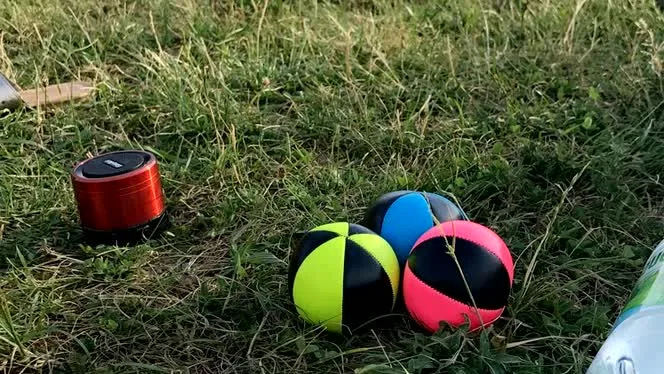
The photo shows three neon balls in the grass, not being juggled - resting there after a drop or between throws. This is what practice actually looks like most of the time: the props at rest, the practitioner recovering, the next attempt not yet begun.
Practice is mostly preparation and recovery punctuated by brief moments of the pattern running. The pattern running is what people photograph and what people remember about juggling. The balls in the grass between attempts is the part that actually builds the skill.
Understanding that practice is mostly this - setting up, trying, recovering from the drop, setting up again - changes how you think about beginner sessions that feel like more dropping than juggling. They are not failed sessions. They are exactly what practice looks like at the beginning.
The visual contrast as a useful instruction
Neon balls in green grass is a high-contrast image. The colors are designed to be visible in low-light conditions, which means in daylight against natural backgrounds they are very easy to find.
This is a practical choice that most jugglers who practice outdoors make: use props that are easy to recover quickly after a drop. The faster you can pick up what you dropped, the more throws you can make in the same amount of time. Reducing recovery time increases the density of useful practice.
The same logic applies to technical learning environments. The faster the feedback loop - the shorter the time between writing code and seeing the result - the more practice cycles you can fit into a session. Short feedback loops are not just more pleasant. They are more productive because they increase the density of the learn-adjust cycle.
The field is always available
A studio has to be booked. A field is wherever there is grass and some space.
The balls in the image are in ordinary grass, in ordinary light, with no apparent preparation. The practice happened here because here was available and the props were present.
That is the full set of conditions required. Everything else is preference.
Read next: Practice Follows You - what happens when the practice shows up on a boat.