 AI-generated
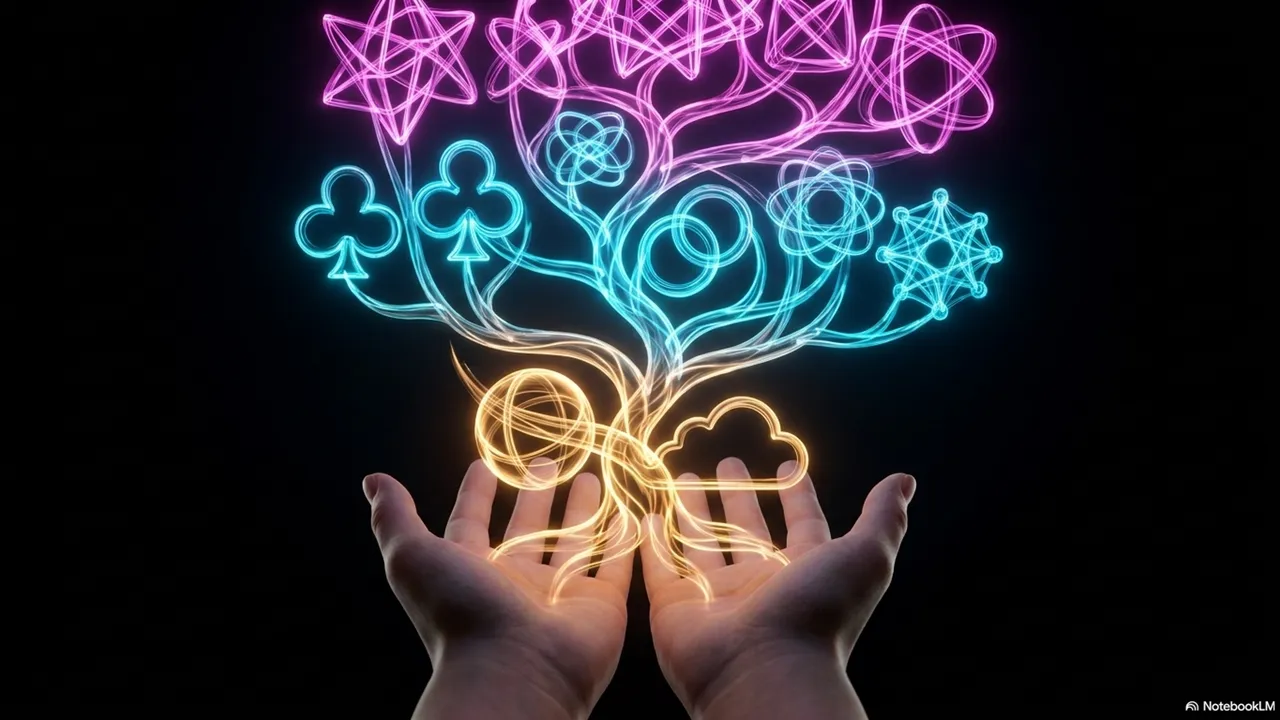
The tree in the image does not grow from soil. It grows from two open hands.
Look at what it branches into. Not just juggling props - though those are there, clubs and rings forming in the upper spread of light. Also: molecular structures, logic gates, circuit patterns, mathematical notation, something that looks like an atom. The same hands that held the first ball are now the root system for a dozen different domains.
This is what one practice, deeply enough held, actually does.
What the research found
The most-cited study in the neuroscience of juggling - Draganski et al., published in Nature in 2004 - recruited 24 people who had never juggled. Half were trained to juggle a three-ball cascade over three months. Half were not.
MRI scans before training and after showed measurable increases in gray matter density in the mid-temporal cortex - the region responsible for processing visual motion - in both hemispheres of the jugglers. Not theoretical, not self-reported. Measured. Physical growth in brain tissue.
The effect was not permanent. When participants stopped practicing after the scan, the gray matter partially receded. Boyke et al. replicated the finding in 2008 with adults aged 50-67, a population previously thought to have largely fixed brain structure. The effect held.
But here is the part that rarely gets mentioned: the region that grew is not the “juggling region” of the brain. There is no juggling region. The mid-temporal cortex processes visual motion in all contexts. The juggler who developed this capacity developed it for everything that moves through their visual field. The tree branched beyond its origin.
The T-shape and the tree
There is a model for professional development called the T-shaped person: deep expertise in one area (the vertical stroke) combined with broad enough capability in adjacent areas to collaborate across disciplines (the horizontal stroke). It is a useful model.
But the tree in the image suggests something slightly different. The T-shape implies that the depth and the breadth are cultivated separately - you build your specialty, and then you develop adjacent skills. The tree suggests that the depth itself generates the breadth. The roots feed the branches.
In the practice of any deep skill - juggling, programming, cooking, surgery, instrument-playing - the depth creates capabilities that migrate. The programmer who gets genuinely good at debugging develops a pattern-recognition capacity that applies to diagnosing mechanical problems, parsing medical information, finding logical inconsistencies in an argument. They did not set out to develop those skills. The root grew them.
Why juggling in particular
Not every deep skill branches in the same way. Expertise in stamp collecting may deepen your historical knowledge but it doesn’t necessarily restructure your visual processing.
Juggling is unusual because it requires several different cognitive systems operating simultaneously:
The visual system has to track multiple moving objects at once - not sequentially, as you might read text, but truly simultaneously, maintaining spatial position for each object across time. This trains a specific multi-object tracking capacity that is genuinely rare and genuinely transferable.
The motor system has to execute different actions with each hand while coordinating them through time. This bilateral coordination - doing different things simultaneously on each side - recruits neural pathways that single-sided activities do not reach. Playing piano recruits this too. Most activities do not.
The error-correction system has to anticipate problems before they fully arrive. In juggling, the catch of ball 2 determines the throw of ball 3. You are always working on the next problem before the current one has resolved. This forward-looking error correction is exactly the mental structure of good debugging, good cooking, good surgical technique.
The branches in the image are not decorative. They are the actual domains that get improved by the practice - not because juggling is magic, but because it happens to train exactly the right combination of cognitive systems that transfer broadly.
The hands are the foundation
The tree in the image grows from two open hands. Not from a machine. Not from a diagram. From the physical, specific, embodied act of holding something and throwing it and catching it.
This is not incidental. The research on embodied cognition suggests that the body is not just the instrument of the mind - it is part of the thinking apparatus. Physical practice changes the mental model in ways that purely conceptual practice does not. The juggler who learns to correct their throw without consciously deciding to correct it has built something in the body that the person who only thinks about juggling hasn’t.
| Juggling | Skills that branch from juggling practice |
|---|---|
| Multi-object visual tracking (keeping 3+ balls in view simultaneously) | Software debugging with multiple concurrent log streams; surgical monitoring of multiple vital signs; financial watching of correlated assets |
| Anticipatory error correction (the next throw is already being planned before the current catch) | Writing code while anticipating the next function's requirements; cooking with multiple timers; project management across parallel workstreams |
| Bilateral motor coordination (left and right hands doing different things on the same timeline) | Keyboard and mouse simultaneously; two-hand instrument playing; surgical bimanual technique |
| Tolerance for the in-between state (ball in air, outcome not confirmed, must continue anyway) | Asynchronous systems waiting for callbacks; leadership during organisational change where outcome isn't visible yet; parenting |
References: Draganski B et al., Nature 2004. Boyke J et al., Journal of Neuroscience 2008.
Read next: You Are the Center of the Pattern - the stillness that makes the pattern possible.