 AI-generated
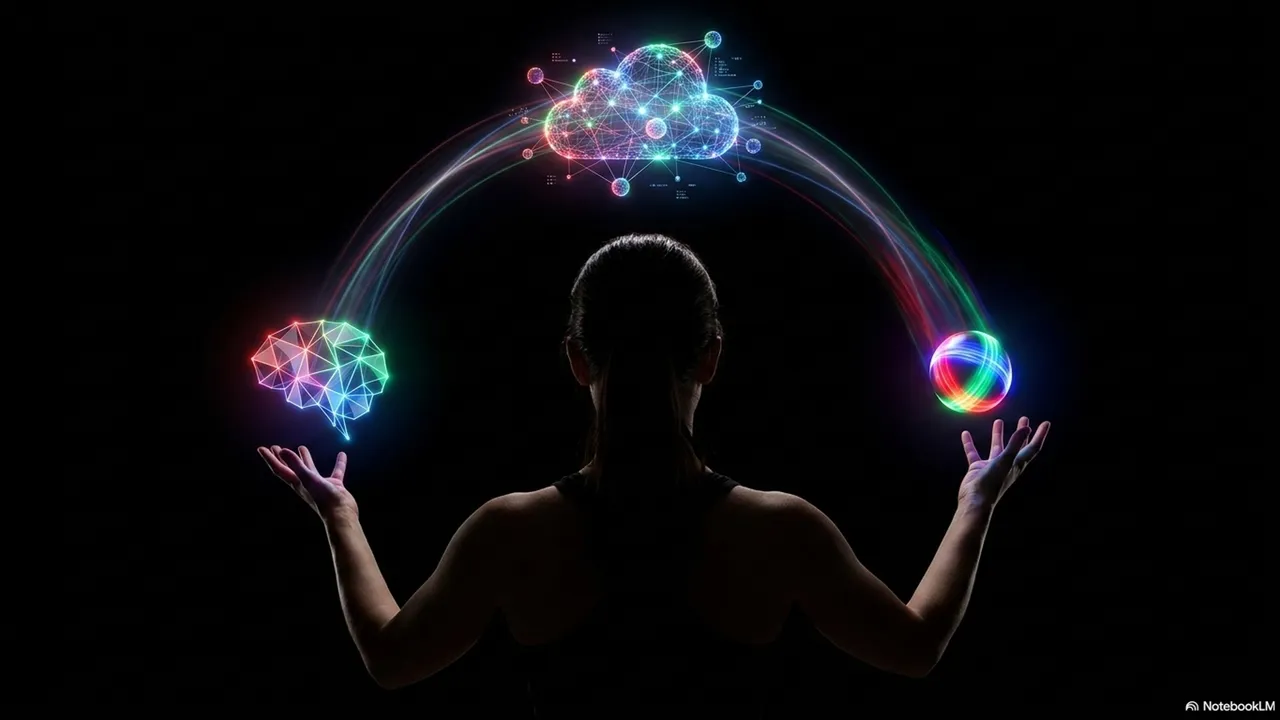
The person in the image is holding two things and watching a third.
Left hand: a geometric brain, rendered in colorful light, angular and precise. Right hand: a glowing ball, soft and round, shifting through the full color spectrum. Above, between them: a rainbow arc rising through a luminous cloud, particles streaming upward, data in motion.
Three elements in one image. Three things in balance. This is not an abstract diagram of how AI, cloud, and human cognition relate. It is a juggling pattern - a dynamic, maintained balance between elements that each behave differently and require different handling.
What each prop does
The geometric brain in the left hand is the human reasoning component: structured analysis, domain expertise, judgment developed through experience, the patterns a person has learned to recognize. It is angular because real expertise has edges - it is specific, not general. It is light-traced because thought is also movement, not storage.
The ball in the right hand is the creative and generative component: open-ended, flowing, capable of taking many shapes. In the context of modern work, this is the exploratory, iterative, uncertain part of the process - the part that tries things, makes new connections, plays with possibilities before committing to any of them.
The cloud arc above is what connects them. It is not a metaphor for “the internet” or for a specific cloud provider. It is the infrastructure that carries the exchange - the thing that takes structured human reasoning and connects it to generative exploration, that enables what neither hand can produce alone.
The balance is maintained, not fixed
The image shows the person at rest, holding both props and watching the arc. But this is a still frame from what is clearly a dynamic process. A moment after this, one prop will be released - thrown upward, traded, passed. The other will be adjusted to receive the return.
This is how the actual workflow runs.
A knowledge worker does not hold both the structured expert judgment and the generative exploration simultaneously at maximum intensity. They alternate - releasing one to focus on the other, catching the return when it comes back. The cloud arc is the timing mechanism: the beat that tells you when to throw and when to catch.
When AI tools work well in a knowledge work context, the human releases a problem into the generative space, observes what comes back, applies structured judgment to evaluate it, refines, releases again. Neither party holds the pattern alone. The exchange is the value.
What breaks the pattern
The pattern breaks in the same ways any juggling pattern breaks.
The three elements are not interchangeable
Each of the three props in the image has a different weight, a different color, a different behavior.
The brain is structural - it changes slowly, it accumulates, it is the stable orientation that persists through many throws and catches. You do not rebuild expertise on every exchange.
The ball is generative - it flows, changes color, takes the shape of whatever the moment requires. Its value is in its flexibility. Trying to make it rigid defeats the purpose.
The cloud arc is a conduit - it carries what is given and returns what it produces. Its job is to be fast, reliable, and transparent enough that the juggler can trust the return without investigating how the arc works before catching.
Building modern knowledge work systems means attending to all three of these, distinctly and in proportion. Not collapsing them together. Not substituting one for another. Holding all three - and maintaining the exchange.
Read next: Brain. Tech. Change. One Pattern. - the same three-element cycle at a larger scale.