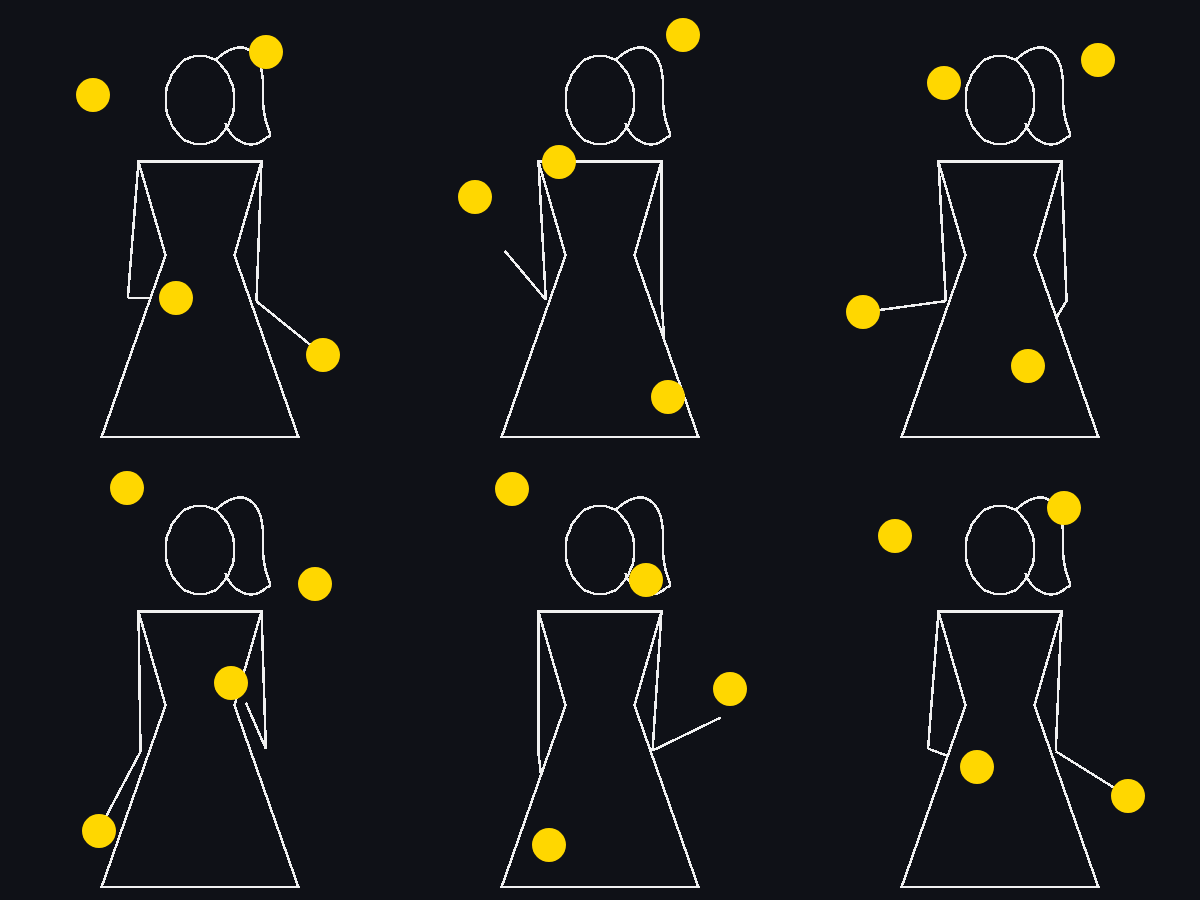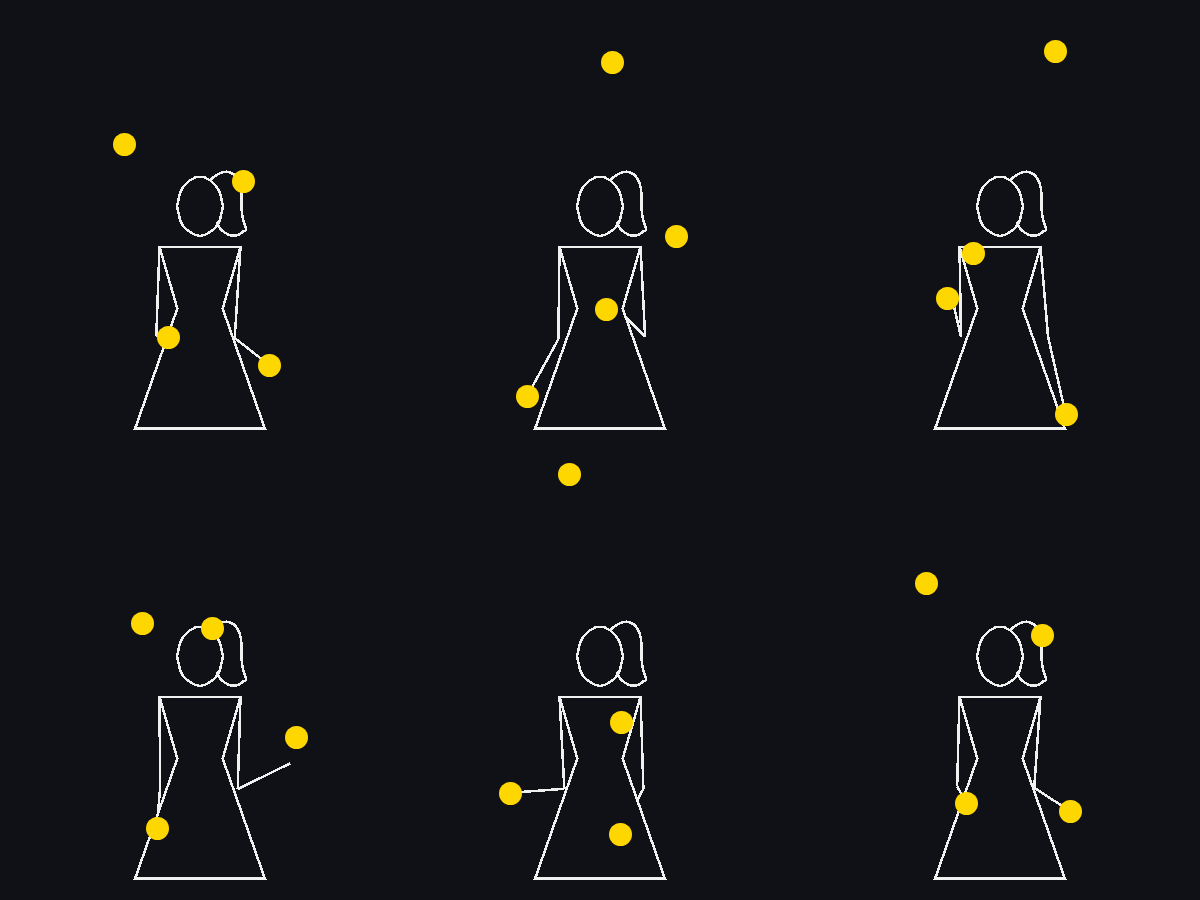
Siteswap 3
Cascade (Siteswap 3)
Round-robin: each object takes 3 beats before returning. Equal load, equal distribution, no priority queue.
The club pass is a contract. The cascade is a load balancer. The cat's cradle is a service mesh. Juggling notation was solving distributed timing problems before distributed systems had a name for them.
Direct mappings
Siteswap notation was invented in the 1980s to describe timing sequences across multiple concurrent objects. It is, in essence, an async timing model with handoff protocols.
Timing, handoff point, and shared protocol must be agreed before the throw.
Equal distribution, no queue backup, predictable arc per slot.
Strings are dependencies. Pull one and all others shift.
The pattern keeps running. The dropped prop is retrieved on the next open beat.
Each number is the number of beats before that object is thrown again.
Two objects leave one hand at the same time - higher throughput, more complex catch.
In club passing, two jugglers exchange props at agreed intervals. The contract has three terms: the timing window (when the pass leaves), the arc height (what trajectory to expect), and the catch position (where the receiver will be). Violate any one term and the pattern breaks.
API contracts work identically. The timing window is the SLA. The arc height is the payload structure. The catch position is the endpoint schema. When a service changes its payload without versioning the contract, the receiver is standing in the wrong place for a pass they did not know was coming.
The most important moment in club passing is not the throw. It is the half-second before, when both jugglers have already confirmed the contract through eye contact and body position. The throw is just execution. The agreement was made earlier.
In distributed systems, this is the handshake. The data in flight matters less than the protocol negotiated before the first packet left. Two services that speak the same protocol can drop packets gracefully. Two services that assumed agreement fail without knowing why.
 AI-generated
 AI-generated
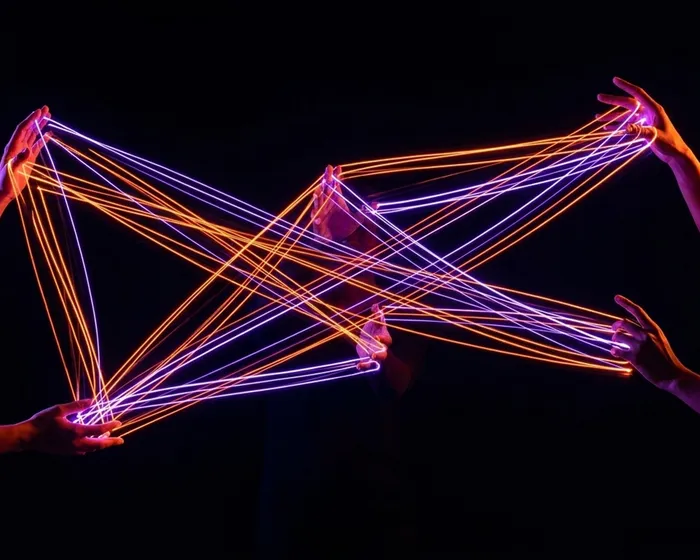
Cat's cradle is a two-person string game where the pattern is transferred between hands while maintaining structural integrity. Pull one string incorrectly and the entire figure collapses. There is no partial failure - the topology either holds or it does not.
This is the event mesh model. In a properly configured service mesh, every service is connected to every other through the mesh fabric - not point-to-point, but topologically. A single misconfigured route does not just break one connection. It changes the shape of the whole.
Cloud architecture made the arc invisible. When your application runs on managed infrastructure, you do not see the throw. You see the catch - the result, the latency, the response code. The arc happened in someone else's data centre, behind an abstraction layer that hides the trajectory.
Juggling makes the arc visible by definition. You cannot hide it. The ball in the air is evidence of a decision made 400 milliseconds ago. Distributed tracing is juggling's visibility applied to invisible systems.
Siteswap 3
Round-robin: equal arc, equal interval
Siteswap 0
Zero: the hand is empty, no object scheduled
Siteswap 4
Fountain: each hand runs its own independent loop
Multiplex
Batch: two thrown simultaneously, complex catch
DNA is a double helix: two strands, complementary, running antiparallel. The information in one strand determines the other. Neither is primary. Both are required. Change in any organisation has the same topology - a technical strand and a human strand, antiparallel, each defining the other.
When cloud migrations fail, the technical strand usually worked. The failure was in the human strand - the teams that did not understand the new deployment model, the security teams that were not looped in, the product managers who kept shipping features while the foundation was being replaced.
Siteswap notation was invented to solve distributed timing. Each number is the time-to-next-throw for that object. It is a scheduling algorithm expressed as a juggling pattern.
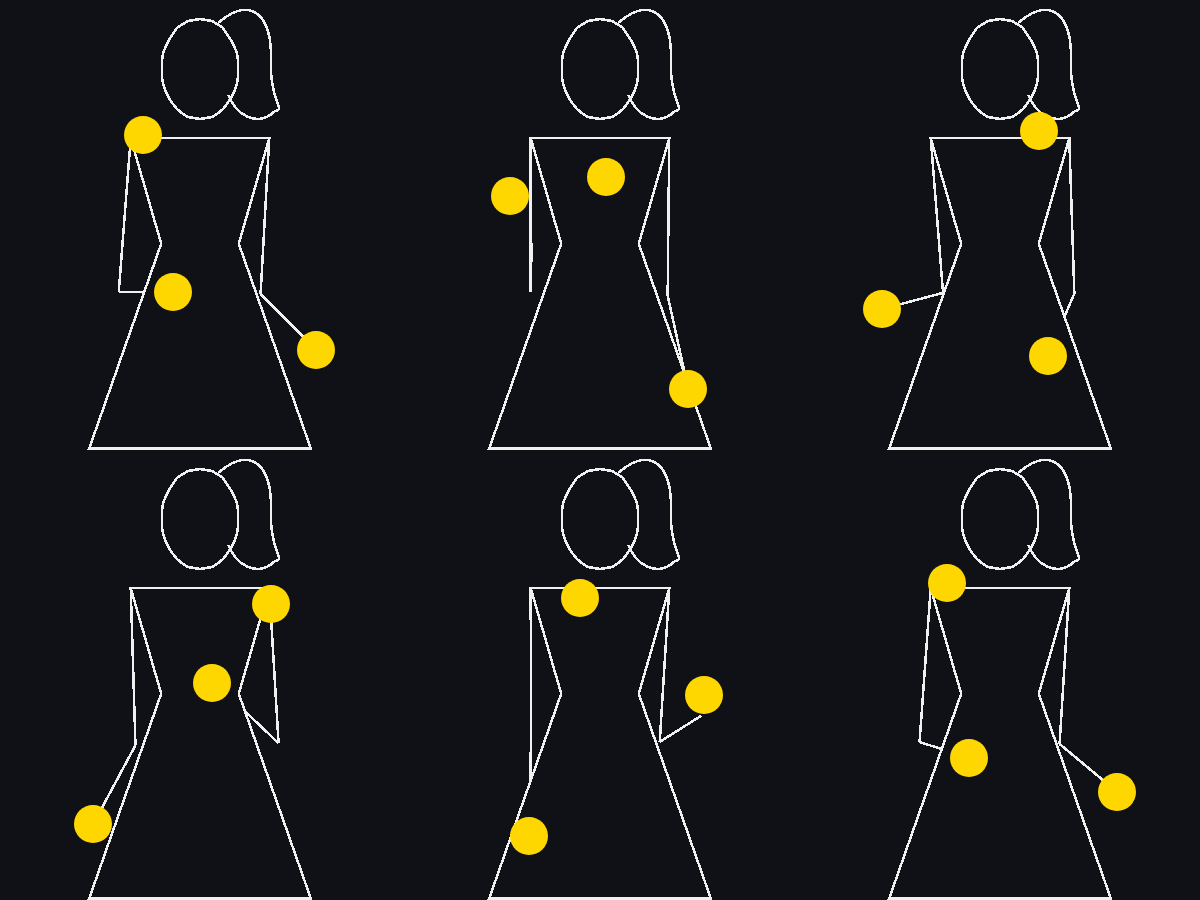
Siteswap 3
Round-robin: each object takes 3 beats before returning. Equal load, equal distribution, no priority queue.
Siteswap 4
Each hand runs independently. Two parallel loops, no cross-traffic. The microservice model.
Siteswap 534
Three different timing windows. The 5 is in flight while the 3 lands and the 4 is scheduled. Concurrent async operations.
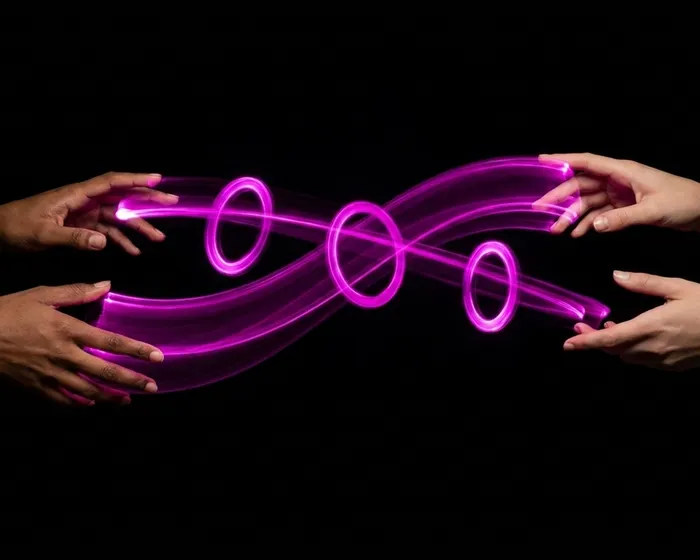
The image shows two pairs of hands facing each other with a magenta infinity loop of light flowing between them - three looping rings crossing in the space neither person holds. What is created in the exchange is not owned by either person. It lives in the space between.
ReadThe image shows multiple pairs of hands manipulating a DNA double helix made of light - orange/amber strands and cyan and pink strands crossing in the center. The helix is not a metaphor for complexity. It is a metaphor for architecture: two strands running in parallel, each carrying information the other doesn't, held together by the bridges between them.
ReadThe image shows multiple hands holding a complex cat's cradle of neon strings - orange and purple lines weaving an intricate structure across the space between them. Every strand is load-bearing. Remove one, and the geometry changes. This is the architecture of every real system: not a clean diagram but a web of dependencies where nothing is truly independent.
Read