 AI-generated
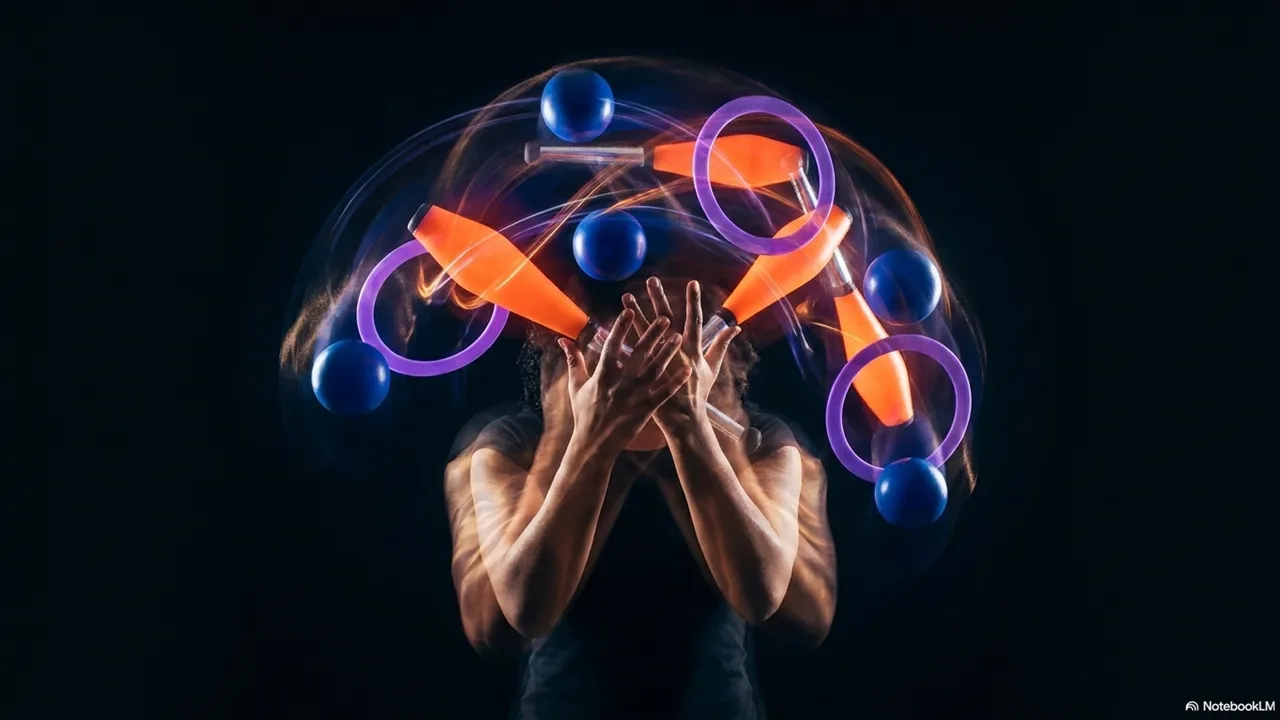
The long-exposure image captures something that a single frame never could: everything in motion at once.
You can see three completely different things happening simultaneously. Blue balls trace clean arcs - smooth parabolas above open hands. Orange clubs spin in the air with their rotation trails visible, each one a different point in its own arc. Purple rings orbit in wide loops, their continuous path requiring constant attention to orientation.
The juggler at the center is one person. All three patterns are running. None of them have been paused.
This is what an organisation looks like during a major change programme at full speed.
What the blur is telling you
The motion blur in this image is not a failure of the camera. It is the accurate representation of what is happening.
The balls are blurred because they are moving. The clubs are blurred because they are spinning. The rings are blurred because their continuous orbit takes them through space faster than a single exposure can capture. If you wanted a sharp image of any one prop, you would need to freeze the frame - and freezing the frame means the other props are no longer where they were. You cannot have sharp focus on all three simultaneously.
This is the central challenge of change management at full speed. If you want complete clarity on how the finance team is progressing, you pull your attention from the clubs - from the security team that is rebuilding its threat model from near-zero. If you focus entirely on the ring departments - the teams furthest from the change who need the most support - the ball departments accelerate without governance and the club departments plateau without coaching.
The blur is the programme running. The blur is what full-speed looks like.
Three patterns, one person, simultaneous
The technical challenge of running balls, clubs, and rings simultaneously is not simply “more of the same”. Each prop follows different physics. Each requires different muscle memory. The timing that works for a ball throw is wrong for a club - the release point is different, the flight time is different. The attention required for a ring’s continuous orbit is different from the attention required for a ball’s peak-and-fall.
Running all three simultaneously means holding three different timing systems in your body at once. Not thinking about them - thinking is too slow. The patterns have to be embedded deeply enough that each can run on its own while the others run too.
The change manager at the center
The juggler in the image is not watching all three props simultaneously. That is physiologically impossible. What they are doing is something more sophisticated: they have calibrated their peripheral vision so that each prop entering a danger zone triggers a response before conscious attention is required.
The clubs come back within a certain window. If they don’t, the juggler knows - not because they are watching the clubs, but because the expected sensation of catching hasn’t arrived. The rings continue their orbit without constant tracking because the arc is predictable once established. The balls demand the most active attention but also forgive small corrections.
This is change management at the level of embodied practice.
The change manager who is still consciously tracking every department in every meeting is a beginner. The experienced practitioner has calibrated peripheral vision - they know which signals indicate a prop entering a danger zone and can respond before it drops, while maintaining the pattern with the other departments.
When one prop drops
The image is a blur of everything in the air. But the cascade in an organisation is not always this clean. Sometimes a club drops. A department falls behind faster than expected. The ring that was orbiting cleanly loses its angle and wobbles.
The question is not how to prevent drops. Drops happen. The question is what you do while one prop is on the floor.
In juggling, dropping one prop does not mean stopping. You continue the pattern with the remaining props, reach down without breaking rhythm, retrieve the dropped item, and reintegrate it. The practitioner who stops entirely every time something drops never builds the pattern to the level where recovery is possible.
Reading the image as a brief
Before running a change programme, look at this image.
The blur is the programme running. The three separate patterns - each with its own physics, its own timing, its own risk profile - are all in flight simultaneously. The person at the center is not pausing any of them to focus on one.
That is the job. Not sequential management of departments one at a time. Not complete clarity at the expense of forward motion. The blur of everything in the air at once, read well, with the peripheral calibration to know which prop needs attention next.
Read next: Which Prop Are You Holding? - how to map which departments are running which pattern.