 AI-generated
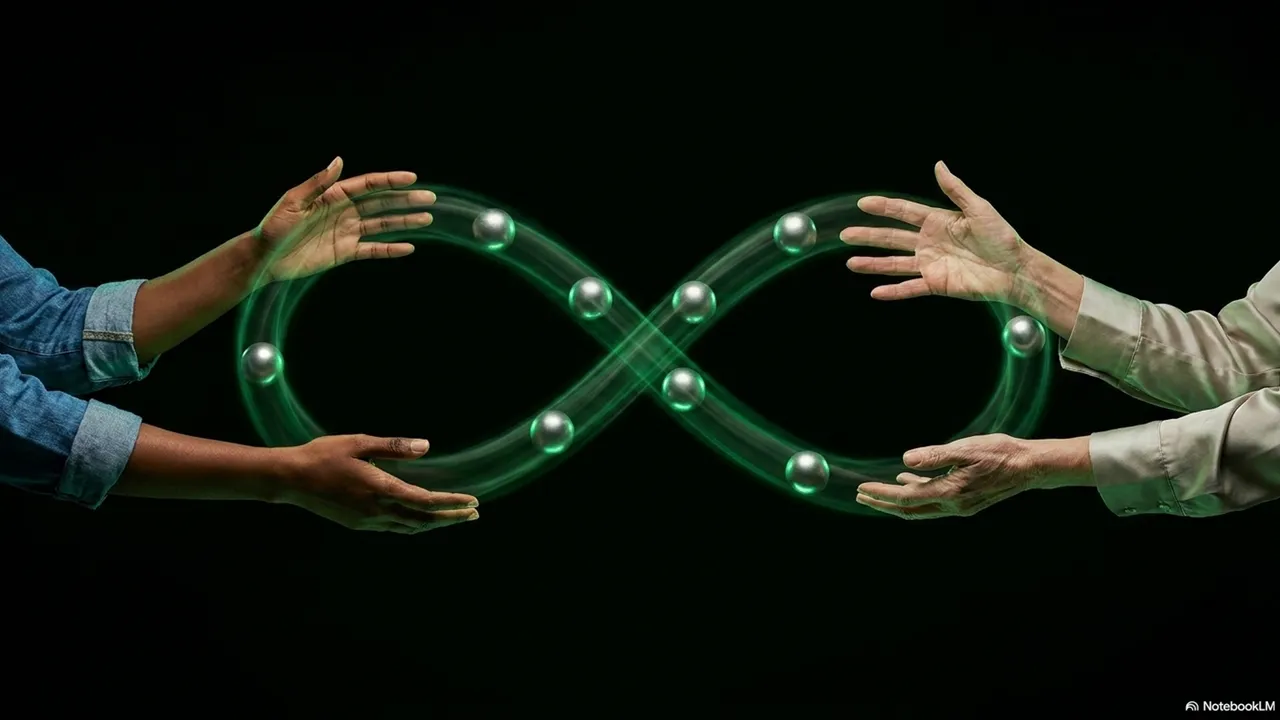
The image shows two pairs of hands reaching toward each other from opposite sides. Between them, a glowing green infinity symbol - the figure-8 loop traced in light - with silver balls positioned along the curve like nodes on a circuit. Neither pair of hands holds all the balls. The loop runs between them, continuous, through both.
This is not a metaphor I constructed for this post. It is what juggling actually is.
The framework
In 1986, philosopher James Carse wrote Finite and Infinite Games, drawing a distinction that has shaped organisational thinking ever since. Simon Sinek built his 2019 book The Infinite Game directly on Carse’s foundation.
The distinction is simple and radical: finite games have fixed rules, known players, and an agreed endpoint. Someone wins. The game is over. Infinite games have changing rules, unknown players, and no endpoint. The only way to “lose” an infinite game is to run out of the will or the resources to keep playing.
Business is an infinite game. Leadership is an infinite game. Life is an infinite game. You do not “win” business. You stay in business - or you don’t.
Juggling is an infinite game. You do not “win” a cascade. You maintain the pattern. If you stop, the balls fall. If you continue, the game continues. There is no score, no opponent, no ending bell.
Five parallels between the cascade and the infinite game
| Juggling | Infinite Game and Juggling |
|---|---|
| No winning condition - the cascade continues or stops, there is no victory state | Just Cause: the goal is not to win but to advance toward a future state that is never fully reached - the cause is the direction, not the destination |
| The drop is information - every failed catch exposes a flaw in timing, eye tracking, or tension that the juggler can use | Worthy Rival: an opponent who beats you reveals your weaknesses and sharpens your practice. The loss is the lesson. |
| Complexity has no ceiling - 3 balls become 5, 5 become clubs, clubs become passing, passing becomes patterns with many jugglers | Existential Flexibility: the willingness to make radical changes to preserve the core while the form evolves |
| Collective play extends the game - a passing pattern between two jugglers requires both to sustain the pattern; one cannot carry it alone | Trusting Teams: the game cannot be sustained by one player alone - psychological safety is the prerequisite for shared continuation |
| The practice is the point - Gelb and Buzan (1994) note that variations with three to five objects are 'if not infinite, sufficiently vast' that even a twenty-year practitioner finds new possibilities | Courage to Lead: choosing the long game over the short win, even when the short win would close down the exploration |
The cascade never ends
A three-ball cascade does not have a final throw. The juggler sets a ball in motion, and the cascade begins. From that moment, the goal is continuation. The next throw, and the next, and the next.
When a juggler adds a fourth ball, they are not starting a new game. They are extending the existing one. The pattern becomes more complex, the timing window narrows, the effort increases - but the goal is the same: continuation. When they add clubs, and when they eventually begin passing with another juggler, the pattern has grown to encompass two people, six clubs, and a rhythm that lives between them rather than within either one.
The field never closes. Michael Gelb and Tony Buzan wrote in Lessons from the Art of Juggling (1994) that the number of possible variations with three, four, or five objects is, “if not infinite, sufficiently vast to challenge even the most gifted practitioner for a lifetime.” Their book was written as a philosophy of mastery - not a juggling manual. The title is precise: lessons from the art, applied to life.
The juggler with seven balls does not “beat” the juggler with three. They are both playing the same game at different stages of its unfolding. The person who has juggled for twenty years and the person learning their first cascade are both infinite players. Neither has finished.
The drop and the infinite player
The finite player experiences a drop as failure. The score has moved against them. The finite frame makes every drop a small defeat.
The infinite player reads the drop differently. A drop is information. It tells you something about timing, about tension in the shoulder, about where the eye went during the throw. The drop is a worthy rival - it showed you something the clean catch wouldn’t have. You pick up the ball and continue.
The passing pattern and trusting teams
The image shows two pairs of hands. Neither can complete the loop alone.
In club passing - one of juggling’s most demanding collaborative forms - two jugglers establish a shared rhythm and throw clubs to each other within it. The pattern only lives if both jugglers maintain it. One cannot carry the loop. The moment one player stops contributing, the shared pattern collapses.
This is Sinek’s trusting teams principle made physical. The loop in the image is only possible if both parties trust the throw enough to catch it. The club that spins through the air between two people is in flight before either has confirmed it can be caught. The trust comes first. The catch comes second.
Organisations that play the infinite game - where the goal is continuation and the game is shared - require the same trust. The pattern that lives between teams, across departments, through handoffs and API calls and asynchronous workflows, only continues if everyone trusts the throw before the catch is confirmed.
Sinek’s five practices, read through the cascade
Sinek identifies five practices for leading with an infinite mindset:
Just Cause - Play toward a vision of the future that does not yet exist, compelling enough that people sacrifice short-term gains for it. For the juggler: the vision is not “juggle five balls” - it is the relationship with the practice itself, the continuous pursuit of what the next level reveals. The balls are not the cause. The exploration is.
Trusting Teams - Psychological safety as the prerequisite for shared continuation. You cannot build a passing pattern with someone you don’t trust. The shared loop only exists where trust already exists.
Worthy Rival - An opponent who reveals your weaknesses is more valuable than one you easily defeat. Every juggler who is better than you is not a threat - they are a mirror showing you what is possible. The drop is the most honest worthy rival.
Existential Flexibility - The willingness to radically change form to preserve the core. Going from balls to clubs is existential flexibility. The juggler abandons what they knew in order to keep playing. The core - movement, attention, timing - survives. The specific form changes completely.
Courage to Lead - Choosing long-term continuation over short-term wins, even when the institution pushes toward the finite. The juggler who adds a fourth ball while still at 80% on three is doing this. The risk is real. The win - if it comes - is not visible from where they stand.
The game that was already infinite
The connection between juggling and the infinite game is not something that has to be constructed. It was already there.
The cascade has no final throw. It has no victory condition. It scales without limit. The drop is informative, not terminal. The most advanced practitioners spend decades finding new variations in the same three-ball pattern.
What Sinek described in organisations, Carse described in philosophy, and Gelb and Buzan approached in practice - the juggler embodies every day in the practice session, without needing to name it. The body learns the infinite game before the mind understands what it is learning.
References: Simon Sinek, The Infinite Game (2019). James P. Carse, Finite and Infinite Games (1986). Michael Gelb and Tony Buzan, Lessons from the Art of Juggling (1994). Draganski et al., Neuroplasticity: changes in grey matter induced by training, Nature, 2004.
Read next: The Change Is Always Juggling - how the same infinite pattern shows up in every organisational transformation.