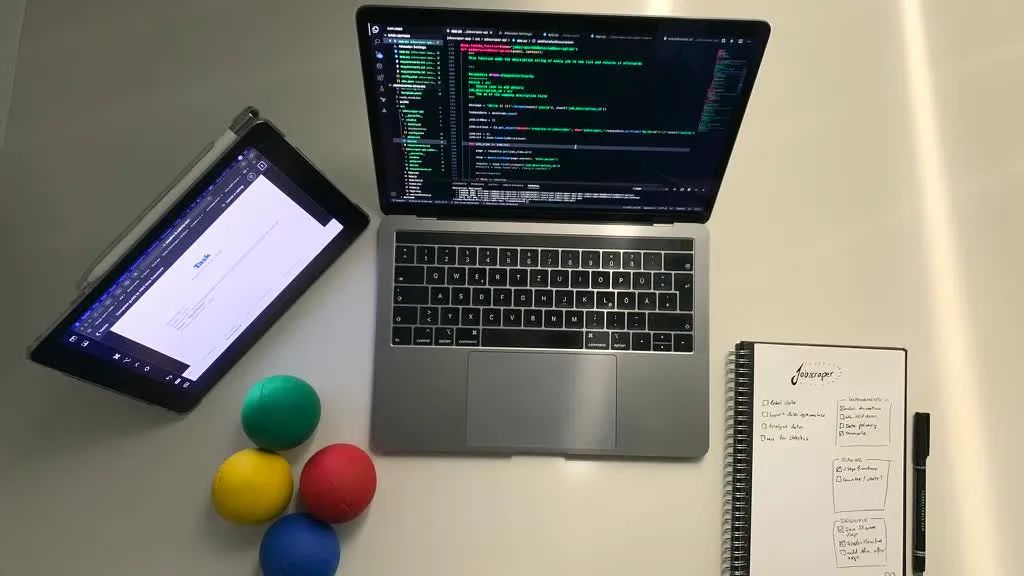
The two things on the desk are not in conflict.
Code on the left. Juggling props on the right. Both get used in the course of a working day, often within minutes of each other. The transition between them is not a break from work. It is a different kind of work.
This is the argument this desk makes by existing.
What each discipline offers the other
Coding is fundamentally abstract. The work happens in representations - text that describes logic, symbols that map to operations, structures that model problems. You can work for hours without any physical engagement beyond typing. The feedback loop is visual and cognitive.
Juggling is fundamentally physical. The pattern is in the body before it is in the mind. The feedback loop is immediate and kinesthetic - the ball either lands in your hand or it does not, and the signal arrives in the moment of the catch, not after you have processed what happened.
Having both on the same desk means the day has both kinds of feedback available. When the abstract work has been going long enough that the thinking becomes circular, the physical practice offers a reset that is faster and more complete than staring at the ceiling. When the physical practice reaches its natural limit, the return to the abstract work brings a focus that long desk sessions rarely have on their own.
The cognitive mechanics
Research on the relationship between physical movement and cognitive performance consistently finds that physical activity improves the quality of subsequent cognitive work - particularly creative and problem-solving work. The mechanism involves increased blood flow and the activation of motor circuits that have lateral connections to prefrontal areas.
The desk in the photo is an implementation of this principle. Not because someone designed it that way, but because two practices that turned out to reinforce each other ended up sharing the same space.
The props are within reach. The code is on the screen. The desk contains both because both belong to the same practice of working with difficult problems.
Alternating, not multitasking
The photo is an overhead view - both things visible simultaneously. But they are not being done simultaneously.
The balls are at rest. The code is on the screen, paused. The desk holds both but not at the same moment. The practice is alternating, not concurrent.
What the desk supports is fast transition. The props are close enough that picking them up takes three seconds, not three minutes. The laptop is open, not closed. The switching cost is low, which means the switching happens at the right moment rather than being deferred until a formal break.
Two disciplines, one practice
The frame for both is the same: a hard problem, a feedback loop, iteration toward something better.
Code has a syntax error or it does not. The ball lands in the hand or it does not. In both cases the feedback is clear and immediate. In both cases the improvement comes from the accumulation of cycles - many small iterations, each one slightly better-informed than the last.
The desk holds two disciplines that turn out to be practicing the same underlying skill in different media.
Read next: The Other Screen - what each type of interface offers that the other cannot.