 AI-generated
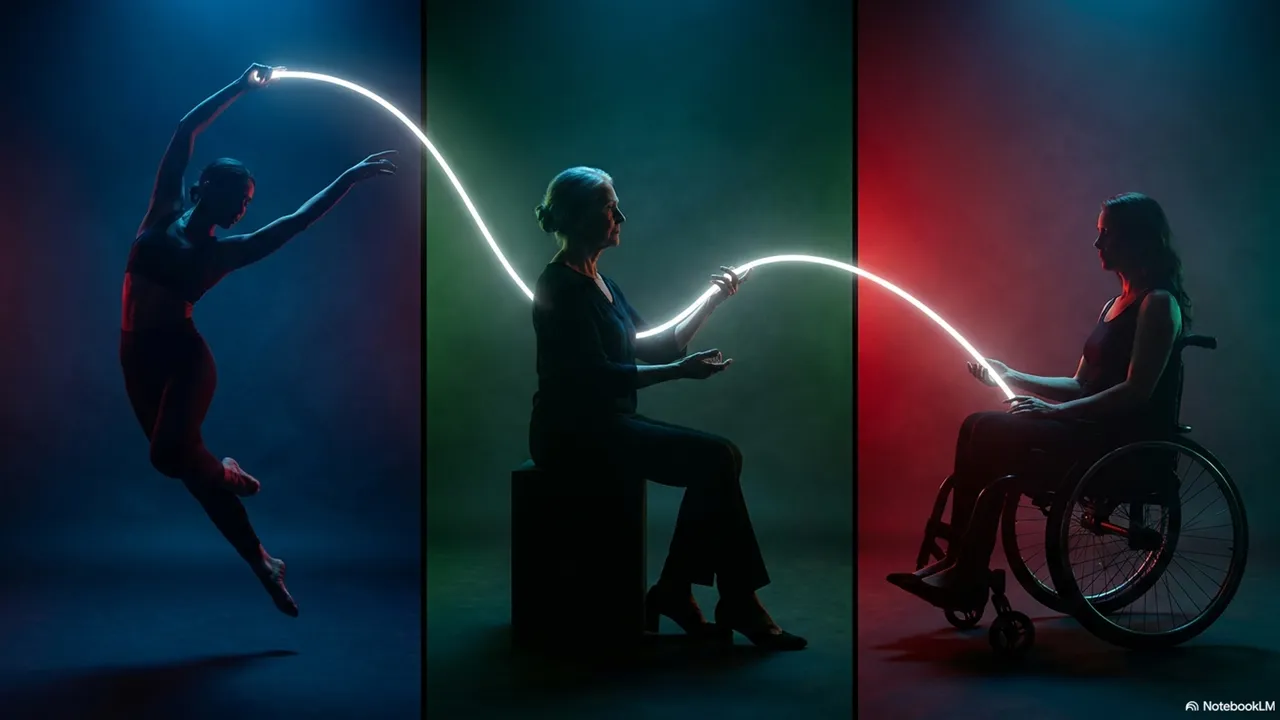
There is one arc of light in the image.
It begins in the left panel, where a dancer is mid-leap - body fully extended, one arm reaching upward. The arc passes through the center panel, where a person sits in still concentration with both hands engaged. It arrives in the right panel, where a person in a wheelchair holds the far end.
Three different bodies. Three different ways of moving. One arc, continuous from edge to edge.
The arc does not require the leap. It does not require the stillness. It does not require standing. It passes through whatever is there and keeps its shape.
What the arc is
The light arc is a juggling prop’s path - the visible trace of something thrown, passed, received. What the image shows is that the path does not belong to one way of moving. A ball thrown from one person to another follows the same arc regardless of how either person stands. The arc is physics. The person receiving it adapts.
This is the argument against prerequisites in learning.
Prerequisites are claims that the arc only reaches certain people. That before you can learn to catch, you need to learn to stand a particular way. That before you can receive the throw, you need to have a certain background. These are usually wrong. They are descriptions of how the skill was previously taught, not descriptions of what the skill requires.
Learning as adaptation, not uniformity
The three performers in the image are not doing the same thing. They are each doing what their body allows and what their attention chooses - and the arc connects them anyway.
For some learners, that means examples first, then concepts. For others, the opposite. The goal is not identical approach - it is that the arc reaches each person in a form they can receive and use.
This is how effective teaching of technical skills actually works. The goal is not for every learner to approach the subject identically. The goal is for the arc - the core insight, the transferable technique, the working mental model - to reach each person in a form they can receive and use.
The different panels are not different levels
The left panel is red. The center is green. The right is red again. None is brighter than the others. None is labeled as advanced or beginner. The dancer’s leap is not more valuable than the seated concentration. The wheelchair does not place the third performer at the edge of the frame in the sense of at the edge of the community.
They are three nodes in the same pattern, and the arc is equally present at each one.
What “no prerequisites” requires
Saying there are no prerequisites and meaning it requires something more than removing the formal requirement.
It requires that the material actually be accessible at the point of entry - not accessible in a watered-down way, but accessible in a way that allows a genuine start. The arc has to be reachable from wherever the learner is standing. Or sitting. Or leaping.
It requires that early questions be treated as good questions - because they are. A question that reveals an assumption the material makes without stating it is more valuable than a question about an advanced edge case, because it points to a place where the arc could reach more people but currently does not.
The arc as shared infrastructure
The light arc in the image does not belong to any one of the three performers. It passes through all of them. If any one of them drops their end, the arc breaks - not just for them, but for everyone connected to them.
This is what a learning community is, at its best: a structure where the knowledge does not live in one place or with one person, where many different people are holding different parts of the arc, and where the shape of the arc is maintained by the participation of everyone who is part of it.
The arc reaches everyone who is willing to hold it. That is the only requirement.
Read next: Everyone Juggles - why the cascade pattern has no body-type prerequisite.