 AI-generated
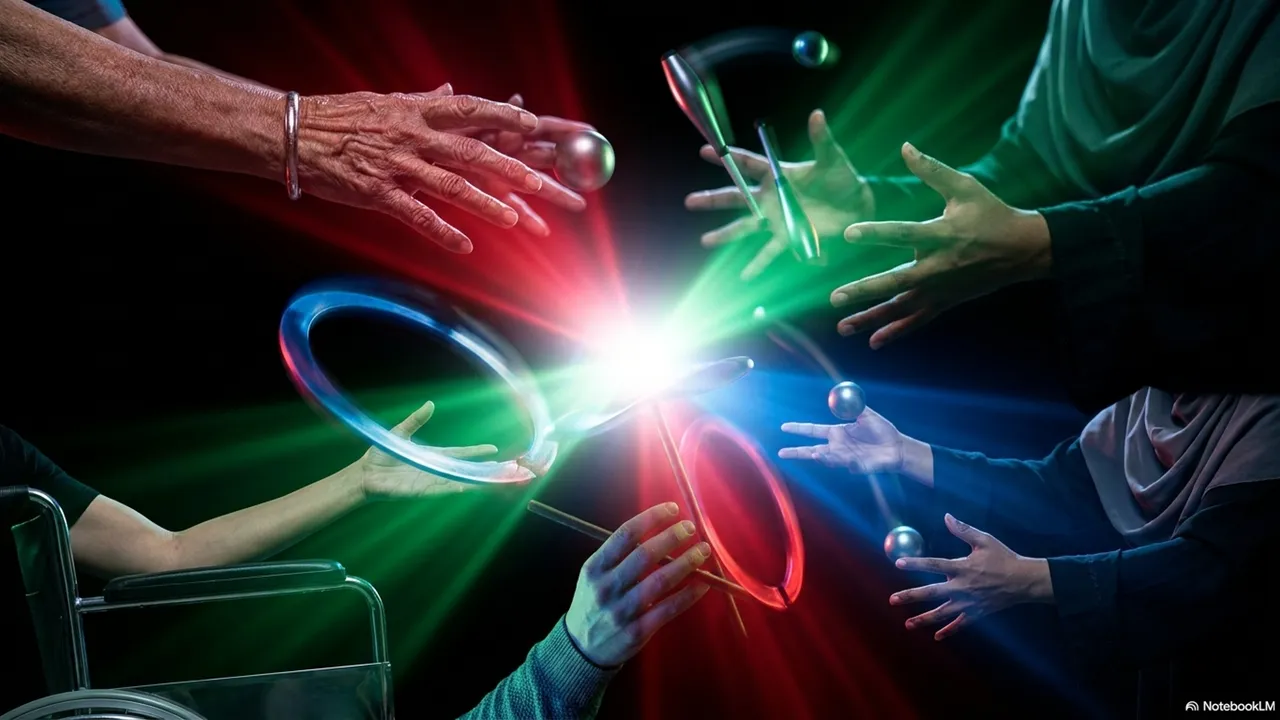
Look at the center of the image first.
Red rings, green clubs, blue balls - the three props converging toward a single point of light, each carried by a different pair of hands. The hands come from different angles, different edges of the frame. Every hand is reaching toward the same center.
Now look at the lower left corner.
A wheelchair wheel. The hand above it is reaching in just like all the others - same angle, same direction, same convergence. The wheelchair does not appear as an afterthought or as a disability marker. It appears as context, the way all the other backgrounds appear: as the specific situation each person is bringing to the practice.
The balls and rings and clubs at the center do not know who is holding them. The pattern does not have prerequisites.
What happens when the entry requirement is removed
Most skill-based communities contain an implicit filter at the front door. The filter is often invisible to those who passed through it without noticing it.
The height filter in basketball is obvious. The wealth filter in golf is obvious. The gender filter that historically governed most professional sports is increasingly acknowledged. But the filters don’t only appear in elite sport. They appear in community activities, in school physical education, in the assumption that certain bodies or ages are “too late” for certain practices.
Juggling has a documented record of not just removing these filters but of actively reaching toward the people they typically exclude.
Programs designed for orphaned children - children who had rarely experienced success at anything, whose relationship to failure had been shaped by circumstances outside their control - used juggling specifically because the pattern of drop-try again-drop-try again eventually succeed is the same regardless of the child’s background. The ball does not respond to the circumstances you arrived with. It responds to the throw you make now.
The convergence in the image
The image is not about accessibility as accommodation. It is about accessibility as what juggling actually is.
The rings at the center meet the clubs and the balls at the same point. The light that emerges from the convergence - that white intensity at the center - is the result of all three props arriving together. Remove any of them and the convergence is incomplete.
This is the organisational and social version of the same pattern. The convergence - the white point at the center where brain science and cloud technology and change management and community practice all meet - requires everyone in the frame. The insights that emerge from this convergence are not available from any single angle. They require the multiple perspectives that different people, different bodies, and different experiences bring toward the center.
When juggling was used with refugees building resilience after displacement, it was not being used as a trick or as entertainment. It was being used because the drop-and-continue rhythm of the cascade is exactly the structure of how a life is rebuilt after disruption: you hold what you have, you throw, it drops, you pick it up, you throw again. The pattern accepts where you are. The pattern does not check where you came from.
What this means for change management
The hands in the image carry three different props. Each prop has been a metaphor in this work for a different kind of experience in organisational change: balls for those closest to the change, clubs for those rebuilding technique, rings for those on a different arc entirely.
But the image shows something that the prop metaphors on their own don’t: everyone is reaching toward the same center. The club-holder and the ring-holder and the ball-holder are not separated by their different props. They are united by their shared direction.
The convergence has no entry requirement. The change programme that understands this - that the person furthest from the change (the ring in the outer orbit) has as much right and as much relevance to the convergence as the person who arrived first - builds something different from the programme that treats the outer-orbit departments as the slow or resistant ones.
The person in the wheelchair in the corner of the image did not require the image to be redesigned to include them. They are just there, reaching toward the same center as everyone else, with a ring in their hand.
That is the point.
Read next: Distance From the Change - the orbital geometry of who is closest to the change and what that requires.