 AI-generated
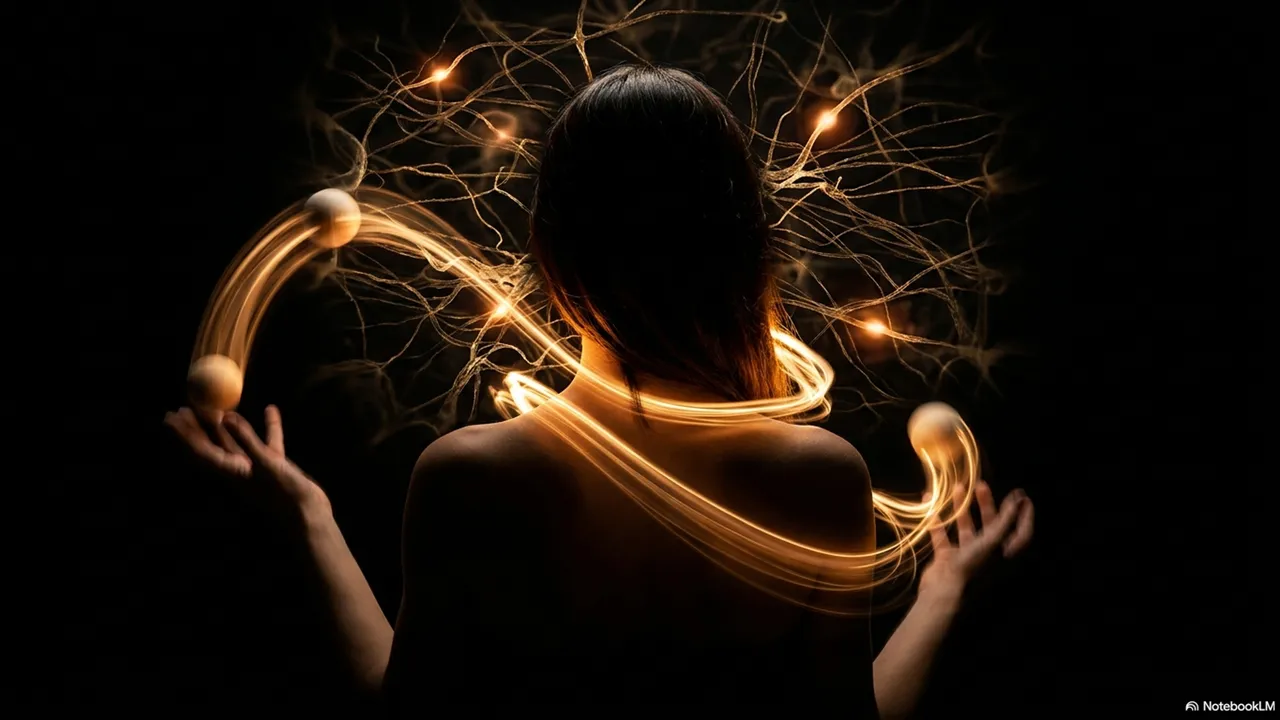
The woman in the image cannot see the back of her own head.
She can see the balls, the arcs, the throw, the space in front of her hands. What is happening behind her - the fine golden tendrils branching outward from the back of her skull, visible to anyone looking at the image from outside - she cannot see at all.
And yet it is the same thing. The golden arc of the cascade and the golden network of neural branching are drawn in the same light, from the same practice, at the same moment.
This is what physical learning actually looks like when you have the instruments to measure it.
What the scan found
The Draganski et al. study, published in Nature in 2004, had a simple design. Twenty-four people who had never juggled. Half were trained to juggle a three-ball cascade over three months. Half were not.
MRI scans were taken before the training period began, after three months of practice, and again after the jugglers stopped practicing.
The results were clear. The juggling group showed measurable increases in gray matter density in the mid-temporal area - a bilateral change, present in both hemispheres. The control group showed nothing comparable.
Then, after the jugglers stopped practicing, the gray matter partially receded. The brain grew the tissue in response to the demand, and partially withdrew it when the demand stopped.
This is what the golden tendrils in the image represent. They are not decorative. They are the physical record of what the hands have been doing.
What the woman in the image knows and doesn’t know
She knows the arc. She has practiced it until the arc became reliable - until the alternating throw-throw-catch-catch rhythm moved from conscious effort to automatic execution. She knows the feel of a clean throw at the right height, and she knows the feel of a throw that is going to come down wrong before it comes down wrong.
She does not know the neural topology behind her head. She cannot see it. The practice has been producing it without her awareness.
This is true of all physical practice at sufficient depth. The practitioner experiences the external arc - throw, catch, drop, try again, drop less, catch more cleanly. The brain experiences a sustained demand that triggers structural response. The two processes run simultaneously. Only one is visible to the person doing the practice.
The arc and the neuron are the same image - one drawn outside, one drawn inside. The practice that changes what you can do also changes the structure of the organ that runs the practice.
Why it has to be physical
The neural tendrils in the image don’t grow from watching juggling videos, or from reading about juggling, or from understanding the principles of the cascade. They grow from the physical act of throwing and catching - from the specific combination of simultaneous demands that juggling places on the system.
Visual tracking of multiple independently moving objects. Anticipatory attention toward where the ball will be, not where it is. Error correction in real time before the current throw has resolved. Left-right motor coordination where each hand is doing something different. Tolerance for the gap between release and catch.
These are not incidental features of juggling. They are the load that produces the adaptation. Remove the physical practice, and you have knowledge about juggling - which is not the same thing.
References: Draganski B et al., Nature 2004. Boyke J et al., Journal of Neuroscience 2008.
Read next: What Grows From One Practice - the domains that branch from a single deep skill.