 AI-generated
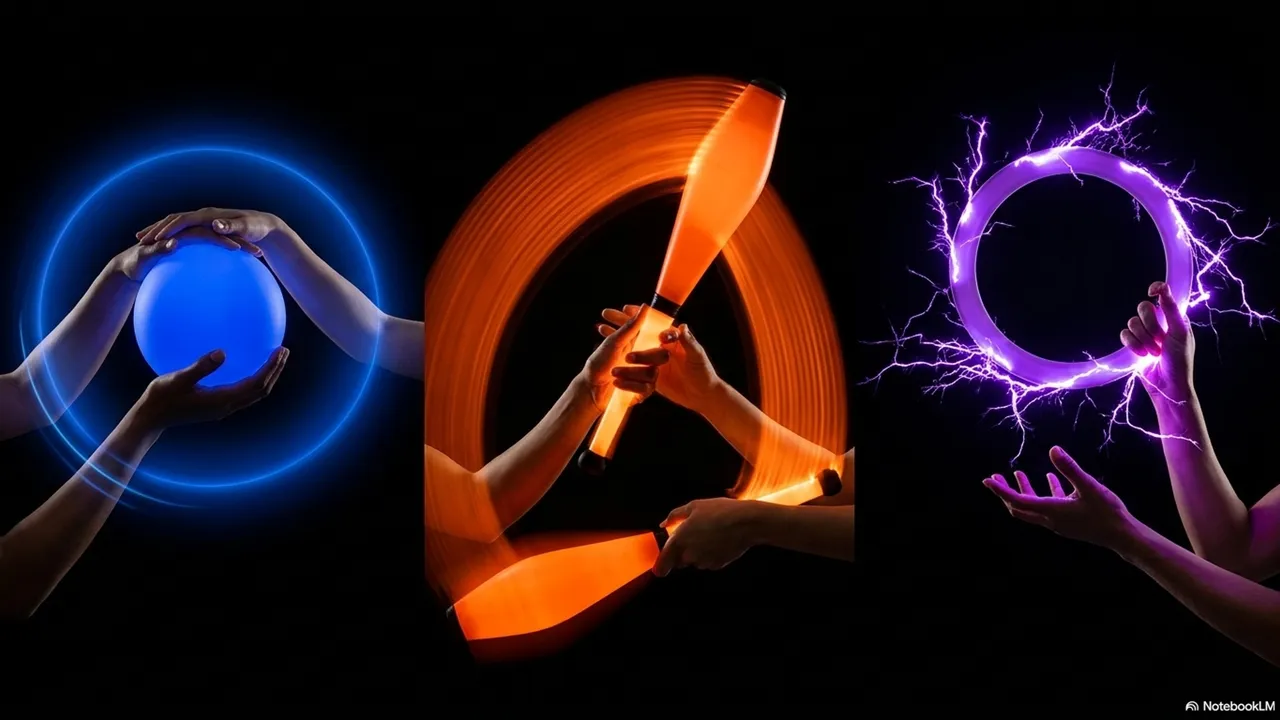
The image gives each prop its own panel.
Not because they are unrelated - all three appear in the same juggling practice, on the same stage, held by the same kind of hands. But because their energetic signatures are different enough that they cannot share a frame without one of them dominating the others.
On the left: the ball. Held in two cupped hands, radiating an electric blue aura - a corona, a field. The ball is at rest in the image, but the energy surrounding it is active. The aura says: this is not inert.
In the center: the club. Gripped in both hands, generating an orange orbit trail from the spin. The club is in motion - you can see the rotational arc around it. The orbit says: the club’s physics are about rotation, not just trajectory.
On the right: the ring. Held toward the viewer, releasing purple lightning from its circumference. The arcs of plasma jump between the ring and the fingers. The lightning says: the ring conducts something, and the conduction is directional.
The ball
The ball is where most jugglers start. It is the prop that tolerates the most error. A slightly mistimed throw still produces a catchable arc. A slightly wrong release point corrects over the flight. The ball absorbs small inaccuracies and forgives them.
This is not a limitation. It is a design. The ball’s role in the learning progression is to provide enough feedback to develop timing and release without punishing every slight deviation. The electric blue aura in the image captures this: the ball’s energy is contained, consistent, radiating uniformly from the center. You always know where the energy is.
The ball also teaches something that the other props do not: the feel of an object at the center of a pattern. The cascade is ball-centric. The coordination structure of the entire three-ball pattern - the timing, the height, the crossing - is built around the ball’s properties.
The club
The club is the prop that most demands that you account for physics you cannot see directly.
When you throw a club, you are not only placing it on an arc. You are also launching it into a rotation. The club that arrives at the catch has been spinning since it left your hand. The catch has to be timed to the rotation - arriving not just at the right position but at the right point in the club’s spin cycle. Too early or too late and the knob hits the palm instead of the handle, and the catch fails regardless of the trajectory.
The orange orbit in the image captures this: the club is surrounded by the trace of its own rotation. The orbit is not decorative. It is the actual physical constraint that the club imposes on the catcher.
The club does not wait for you to be ready. It arrives at the catch with its own momentum, its own rotation, its own timing. Meeting the club is the skill.
The club corresponds to the mid-orbit participants in the change framework - the teams rebuilding technique, working with new tools and methods that have their own physics. The club asks you to account for momentum that was set in motion before you arrived.
The ring
The ring is the most unusual of the three props and the one that most rewards rethinking your assumptions about what juggling is.
The ring can be foot-juggled from a seated position. It can be contact-spun on a finger. It can be rolled along the floor. It is the most structurally flexible of the three because its defining feature - the empty center, the circular continuity - does not require a specific grip or a specific arc to be activated.
The purple lightning in the image captures this: the ring’s energy arcs at the contact point, directional, not contained. The ring conducts what is brought to it.
| Juggling | What each prop asks of the practitioner |
|---|---|
| Ball: soft hands, precise release, tolerance for a long correction arc | Full attention to the immediate change environment; active adjustment in real time; not managing from a distance |
| Club: timing the catch to the rotation cycle, not just the position | Accounting for momentum and physics set in motion before you arrived; the tool or process has its own timing that you have to meet |
| Ring: contact manipulation, active at the boundary, flexible entry angle | Engagement from the outer orbit; the energy is not less but the contact point is different; patience for the longer arc before it returns to center |
| All three: reading which prop is in your hand before deciding how to respond | Recognising which type of organisational participant you are working with - center/ball, mid-orbit/club, outer-orbit/ring - and adjusting the engagement accordingly |
Read next: Everything in the Air at Once - the orbital geometry when all three props are in motion together.