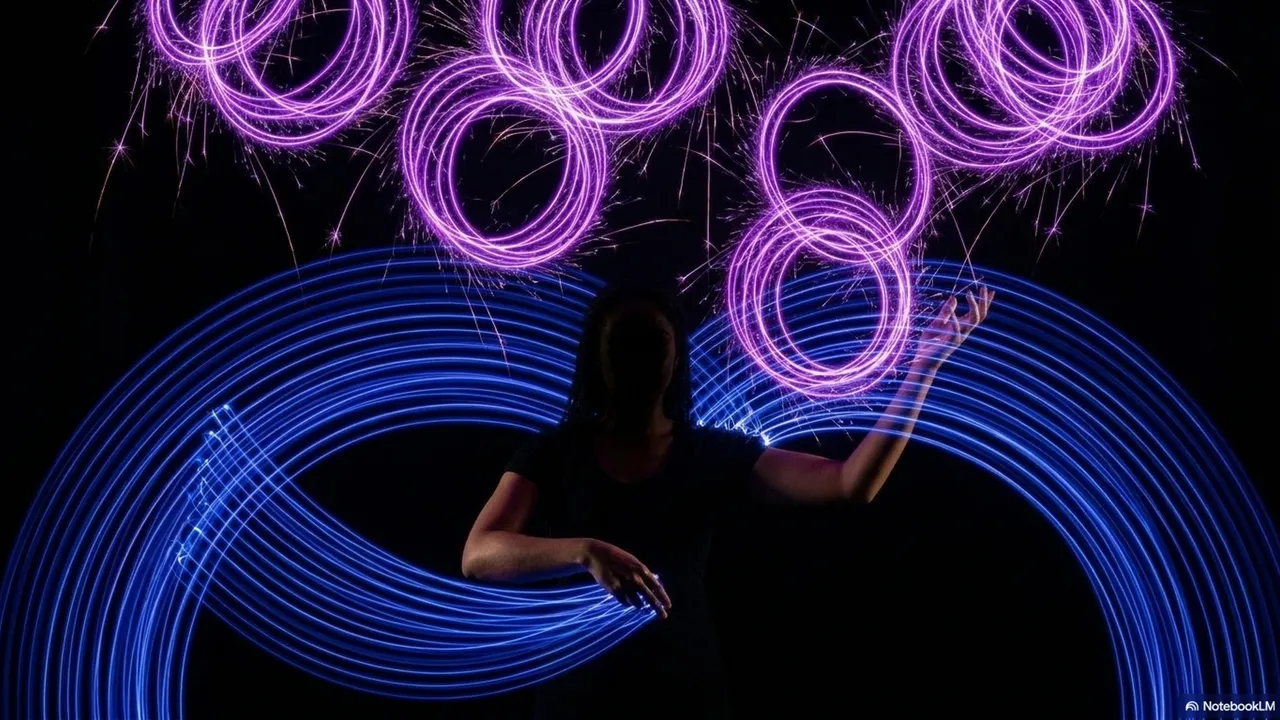
The image shows a woman surrounded by rings at scale - large blue arcs below and around her, and small purple rings sparking and multiplying above. The outer orbit does not stay outer because it is unengaged. It stays outer because its relationship to the change is a different scale, a different arc, a different orbit entirely.
AI-generated
The woman in the image is not overwhelmed.
Look more carefully. The rings surrounding her - the large blue arcs sweeping around her at body level, the smaller purple rings multiplying and sparking above her head - these are not chaos. Each ring has its own arc, its own trajectory, its own orbit. They do not collide. They multiply because the juggler has made space for each one.
The outer orbit does not look like the center. It should not look like the center. When a change program extends to the departments furthest from where it originated, the ring count increases and the orbit radius expands and the relationship to the change looks different from the outside.
This is not disengagement. This is scale.
Large arcs
The long orbit at body level
The blue rings around the juggler are large - wide arcs that take time to complete. The outer-orbit department's relationship to a change is not less engaged; it is longer in duration and larger in scope.
Multiplying above
New rings being added to the pattern
The purple rings above are smaller, sparking, newer. This is what the outer orbit adds: its own concerns, its own rings, its own relationship to the change that the center did not originate.
Not colliding
Multiple rings, coherent pattern
Despite the number of rings, they are not crashing into each other. The juggler who can hold rings at scale has created a pattern in which multiplicity is structural, not accidental.
The outer orbit’s relationship to change
In the orbital framework developed across this body of work, the three props mark three positions relative to a change: balls for those closest to the center, clubs for those rebuilding technique, rings for the outer-orbit departments furthest from where the change originated.
The ring’s outer orbit is not a problem. It is a geometric fact. The department that is five steps removed from the originating change team - the legal function watching an operational transformation, the regional office observing a global digital program, the finance team monitoring a product innovation initiative - has a ring relationship to that change. Long arc, infrequent return, wide scope.
The mistake is treating this as absence. The rings in the image are not absent. They are everywhere. They surround the juggler. They multiply above. The outer orbit is full - it just looks different from the center.
The rings the juggler did not start with
Look at the rings above the woman’s head in the image. They are smaller, more numerous, sparking with something newer than the large blue arcs around her. These are rings that have been added to the pattern, not rings that were there from the beginning.
In change management, the outer-orbit departments do not only receive the change - they add rings of their own. The regional office that adapts the global program to its local context. The compliance team that adds a regulatory ring to the operational change. The customer-facing department that adds a client-experience ring to the internal transformation.
These additional rings are not interference. They are the outer orbit contributing what only the outer orbit can contribute: the rings that the center did not know were in play, from the angle that only the far orbit can see.
The outer orbit is not waiting at the edge to be convinced. It is running rings at a scale the center cannot see from the middle.
What “distance from the change” actually describes
Distance from the change is not distance from the practice. The woman in the image is not half-heartedly spinning one small ring. She is surrounded by rings. The practice is fully present. The relationship to the center is a long orbit, not a disinterested one.
This is the most important reframing for change programs that struggle with outer-orbit engagement. The question is not “how do we get the outer orbit to engage?” - that assumes the outer orbit is currently disengaged. The question is “how do we understand the outer orbit’s current engagement and create the structures that make it visible to the center?”
The rings are already spinning. The program just may not be measuring them.
 AI-generated