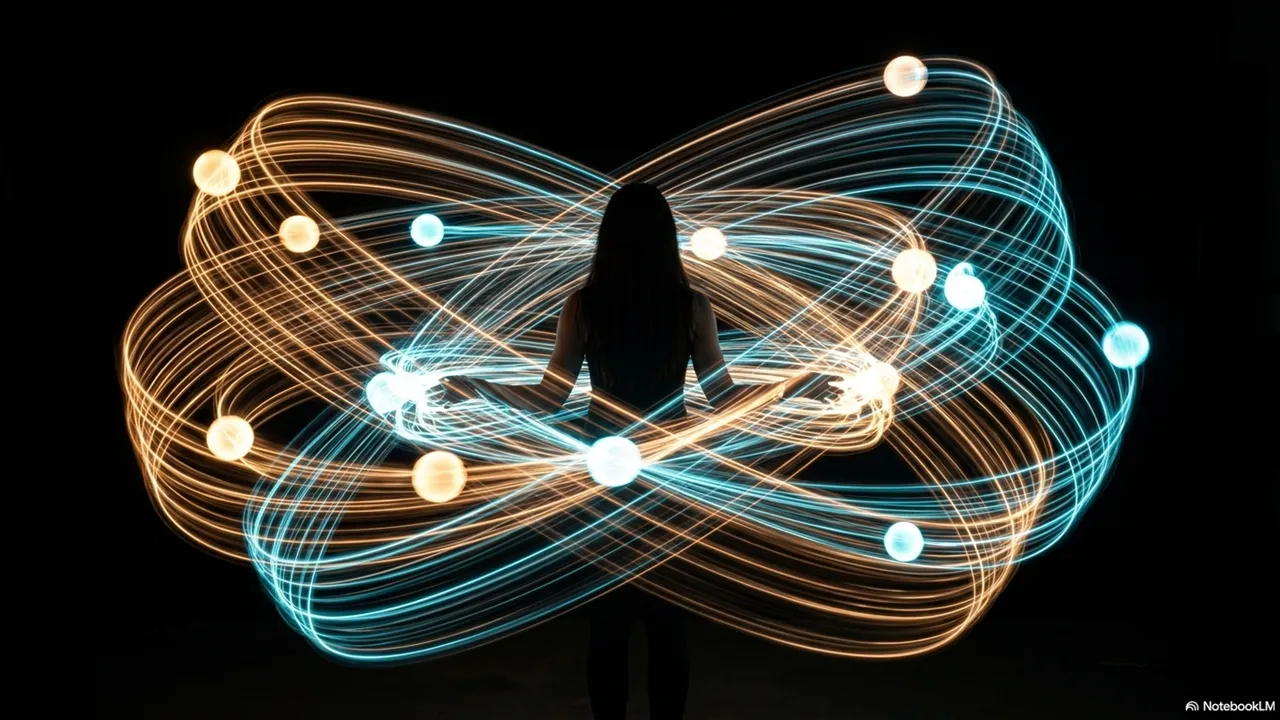
 AI-generated
Look at the center of the image.
The balls are moving - orange and cyan arcs sweeping in wide loops, the figure-eight of their paths traced in light around the person at the middle. The pattern is dynamic, continuous, always changing.
The person is still.
Not frozen. Not passive. Still in the way that a tree is still in wind: rooted, present, the stable axis around which everything else moves. The cascade does not orbit a moving target. It orbits a center.
What beginners do wrong
The most consistent error in new jugglers is drift.
They throw slightly to the side. The ball lands slightly off-center. They step toward it. Now they are off-balance, so the next throw is slightly compensatory, landing on the other side. They step toward that. Within twenty throws, they have shuffled across the room.
The instinct is correct: you move toward what you’ve thrown. But the result is that the juggler becomes a chaser rather than a center. The pattern controls the juggler rather than the juggler holding the pattern.
The intervention is counter-intuitive: stand still. Throw accurately enough that the ball comes back to you. If the ball does not come back, resist the instinct to follow it - instead, throw the next ball more accurately. The correction is in the throw, not in the position.
This takes longer to learn than it sounds. The instinct to chase is deep. Standing still while something you released is drifting away from you requires a kind of trust in the pattern that beginners don’t have yet.
The figure-eight and the flow state
The infinity pattern in the image is not coincidental. The figure-eight - the loop that crosses itself at the center and returns to where it started - is the visual signature of sustained motion without terminus.
The juggler at the center is not trying to reach the edge of the pattern. The edge of the pattern is where the balls are. The juggler is at the crossing point: the center of the infinity, where every loop comes back through before expanding again.
Flow research - Csikszentmihalyi’s foundational work and the studies that followed - identifies the conditions for flow as: a challenge level matched to skill, clear and unambiguous feedback, and full absorption of attention. What is notable about the figure-eight pattern is that all three conditions are embedded in its structure.
The challenge is always just at the edge of the current skill (the pattern can always be made more complex). The feedback is immediate and unambiguous (the ball either returns to the center or it doesn’t). And the absorption is complete - there is no cognitive space left for anything else.
Chasing versus centering in organisations
The same dynamic runs through organisational life, and through change programmes in particular.
The organisation that chases every new development - reorganising around each shift in the market, pivoting strategy at each quarterly signal, restructuring teams in response to each external event - is the beginner juggler shuffling across the room. The pattern controls the organisation.
The organisation that holds a stable center - a clear purpose, established rhythms, a core that does not reorganise every time conditions shift - can allow the edges to move without losing its ground. It is not rigid. A tree is not rigid. It bends. The roots hold.
The question is not whether to respond to change. The cascade is always changing - the balls are always moving, the pattern is always evolving. The question is whether you are the center around which the change orbits, or whether you are chasing it.
What the experienced practitioner looks like
There is a specific quality that distinguishes experienced jugglers from intermediate ones that is not immediately legible to an observer: the experienced juggler is less busy. Their throws are smaller. Their catches are earlier. Their body moves less. The pattern looks effortless because it has been - over years of practice - tuned to require less compensatory motion at every step.
This is not sloppiness. The smaller throw is more accurate. The earlier catch is more controlled. The stillness is not passivity - it is the absence of unnecessary movement, which is itself a form of precision.
Csikszentmihalyi described flow as the experience of “effortless attention” - full absorption without strain. The long-exposure image captures this: the person at the center is completely present and not visibly straining. The pattern around them is complex. The person within it is calm.
The orbit returns
Every throw in a cascade is also a return. The ball that leaves the hand will come back, if the throw was right. The figure-eight always crosses back through the center before it expands again. The pattern does not leave and stay away. It extends and returns.
This is what the experienced juggler trusts: not that nothing will go wrong, but that the pattern they have built is resilient enough to return to them. That a slightly imperfect throw can be corrected on the next catch. That the center they have established is stable enough to be the anchor for whatever the edges are doing.
The image shows the return, not just the departure. The orange arc that extended left is sweeping back toward the center. The cyan arc on the right is at its furthest point and beginning its loop back. Neither ball has escaped the pattern. Both are on their way back.
Read next: Juggling Is an Infinite Game - why the cascade has no endpoint, and what that means for how we lead.