 AI-generated
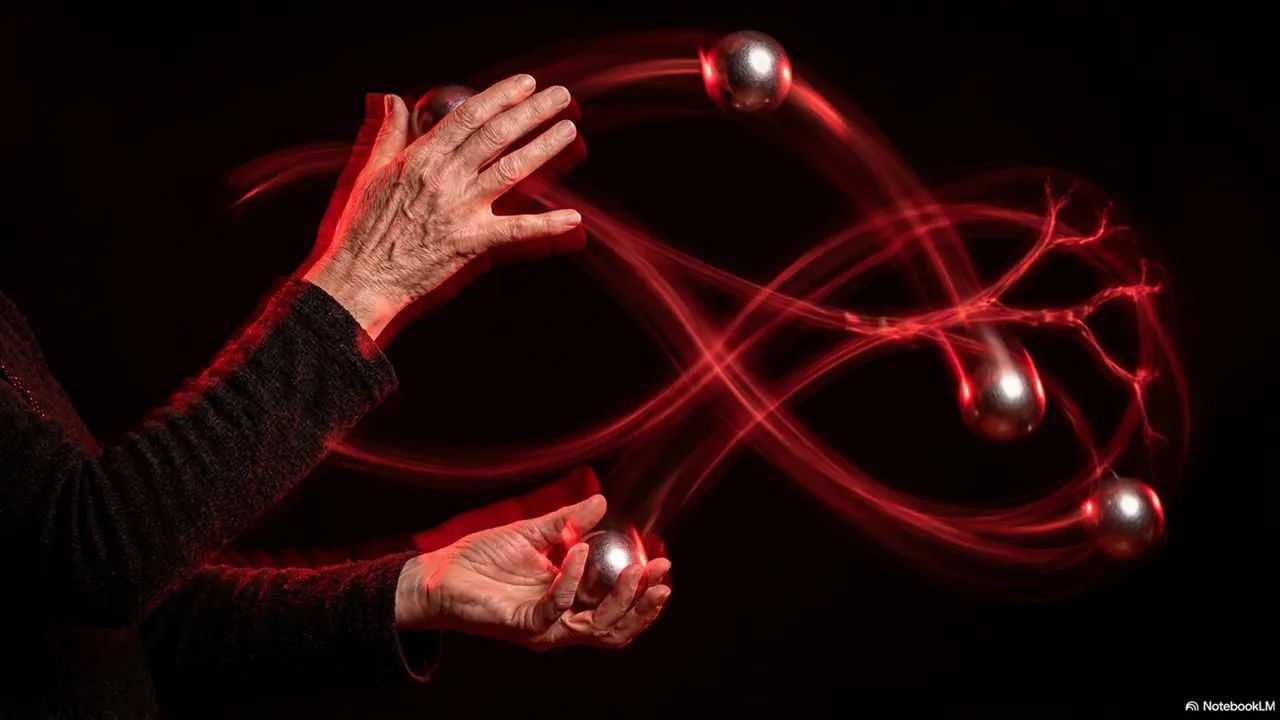
The hands in the image have been in use for a long time.
The wrinkles are visible. The texture and weathering that accumulates across decades of work, of use, of living - these are not hidden or softened. The photographer did not choose younger hands as a stand-in. These are the hands that are here.
And the pattern between them is exactly the same infinity trail as any other juggler leaves. The same arc. The same weight of the balls. The same figure-eight that closes on itself and continues. The red light traces the same loops regardless of whose hands hold the starting point.
The balls do not know how old the hands are.
What the assumption was
For most of the 20th century, the dominant model held that brain plasticity peaked in childhood and adolescence, and that the adult brain was largely fixed in structure. You could accumulate knowledge and skill - the software could update - but the underlying hardware was considered stable.
This assumption was not unreasonable given the measurement tools available. It was simply wrong.
The Draganski study (2004) had shown gray matter growth in younger adults after three months of juggling practice. Boyke et al. ran the same protocol with a different population: adults aged 50 to 67, specifically because this was the age range where the assumption of neural fixity was strongest. If the effect disappeared in older adults, that would confirm the assumption.
It did not disappear. Gray matter density increased in the mid-temporal cortex. The same region. The same bilateral change. The same relationship to visual motion processing that the 2004 finding had established. And - critically - the same partial recession when practice stopped: the older brain, like the younger brain, built the tissue in response to the demand and released it when the demand ended.
The assumption was the problem. The brain was not fixed. It was waiting to be asked.
The infinite game in the hands
James Carse’s 1986 distinction between finite and infinite games describes two fundamentally different orientations toward any ongoing activity. A finite game has a terminus - a winner is declared, the game ends. An infinite game has no terminal point. The goal is not to win but to continue playing.
The hands in the image are playing an infinite game. The red infinity trail is not a metaphor chosen for the image - it is an accurate representation of what infinite-game participation looks like from the outside: a loop that returns to its starting point and continues.
What makes this image different from an image of younger hands producing the same trail is precisely what it is easy to see and easy to dismiss: the age of the hands. These are hands that have been at the practice long enough to carry its record in their texture. The pattern they produce is the same. But the fact that they have been producing it for decades is information the image holds.
The brain of someone who practiced for a lifetime looks structurally different from one that stopped. Not because of age - because of continuation.
What organisations get wrong about senior experience
The assumption of neural fixity has a direct parallel in how organisations treat their most experienced people.
Senior employees are frequently assigned to delivery roles - executing on established patterns rather than developing new ones. New frameworks, new methodologies, new tools are presented as being primarily for the younger cohort. “Change champions” are disproportionately identified from mid-career populations. The implicit model is that the older employee has reached peak capability and is now in a holding pattern.
The juggling research contradicts this in two directions simultaneously.
First, older adults demonstrably grow new neural structure from practice. The hardware continues to update into the sixth and seventh decades of life, given the right kind of demand. The capacity for new growth is not age-limited.
Second, older practitioners bring something the research does not measure but the image shows: the patterns laid down across decades. The infinity trail in the image is continuous not despite the age of the hands but including it. The depth of the pattern, the stability of the arc, the ease with which the loop closes and reopens - these are not separate from the age of the hands. They are what decades of practice looks like.
References: Boyke J et al., Journal of Neuroscience 2008. Draganski B et al., Nature 2004. Carse J, Finite and Infinite Games 1986.
Read next: Juggling Is an Infinite Game - what it means to play a game with no terminal point.